
24 August 2026 · TJ Smile Studio
Can Invisalign fix an open bite, or do you need something more?
Invisalign can effectively treat open bites caused by tooth position. Discover how this solution delivers impressive results for patients.

Yes, in many cases. Invisalign and other clear aligners can close mild to moderate open bites caused by tooth position, and the clinical evidence behind this is stronger than most patients expect. A systematic review and meta-analysis found an average overbite improvement of 2.76mm, and a retrospective cohort study reported that 94% of patients achieved a positive overbite after treatment.
The caveat matters as much as the headline figure. Aligner therapy works well for dental open bites, where the teeth themselves sit in the wrong position. It’s far less reliable for skeletal open bites, where the jaw bones have grown in a way that keeps the front teeth apart regardless of tooth movement.
Three things decide whether open bite Invisalign treatment will work for you:
- The diagnosis. Dental causes respond well; skeletal causes often need surgery or bone anchorage.
- Your compliance. Aligners need 20 to 22 hours of daily wear to move teeth vertically, which is a harder movement than most people assume.
- Whether adjuncts are needed. Elastics or temporary anchorage devices (TADs) often make the difference between a good result and a stalled one.
Key Takeaways
Invisalign corrects mild to moderate dental open bites with average overbite gains of 2.7 to 3.3mm, but skeletal cases need TADs, elastics, or surgery for lasting results.
| Point | Details |
|---|---|
| Diagnosis decides everything | Dental open bites respond well to aligners; skeletal cases usually need surgical or TAD-assisted support. |
| Evidence shows real change | Meta-analysis and cohort studies report average overbite gains of 2.76mm to 3.3mm with aligner therapy. |
| Compliance drives results | Vertical tooth movement needs 20 to 22 hours of daily wear to happen as planned. |
| Refinements are normal | Digital planning tends to overestimate movement, so most cases need at least one refinement phase. |
| Retention prevents relapse | Fixed or removable retainers, plus myofunctional therapy for habit-driven cases, protect the result long term. |
| Local assessment available | TJ Smile Studio in Glasgow offers digital scanning and tailored Invisalign planning for open bite cases. |
This article is general information, not a substitute for advice from a qualified doctor. Consult a qualified healthcare professional about your own circumstances before acting on anything here.
Table of Contents
- Open bite Invisalign candidacy starts with understanding severity
- Causes of open bite: dental, skeletal and functional (habit) factors
- Can Invisalign or clear aligners treat an open bite? A summary of the evidence
- Who is the best candidate for aligner-based open-bite correction?
- How aligners actually close an open bite: mechanics, planning and common auxiliaries
- Treatment journey and timeline: from consultation to refinements
- When adjuncts or orthognathic surgery are required
- Stability and relapse prevention: retention and myofunctional therapy
- Why trust this advice: TJ Smile Studio’s approach to open-bite cases
- What the evidence actually tells us about open bite treatment
- Book an Invisalign assessment with TJ Smile Studio in Glasgow
- Sources
Open bite Invisalign candidacy starts with understanding severity
An anterior open bite means the upper and lower front teeth don’t touch when you bite down, leaving a visible gap. This differs from a posterior open bite, where the back teeth fail to meet, which is rarer and usually points to a skeletal or developmental issue rather than a habit.
Dentists measure the gap in millimetres using the negative overbite value, essentially how far apart the front teeth sit vertically. Most clinical studies group cases as:
- Mild: roughly 1 to 2mm of vertical gap, usually dental in origin.
- Moderate: around 2 to 4mm, often mixed dental and skeletal.
- Severe: beyond 4mm, frequently skeletal and resistant to aligner-only correction.
Severity dictates the whole treatment conversation. A 1.5mm dental open bite is a very different case to a 5mm gap with a long, narrow facial pattern. The latter usually needs a combined orthodontic and surgical plan, not aligners alone.
Causes of open bite: dental, skeletal and functional (habit) factors
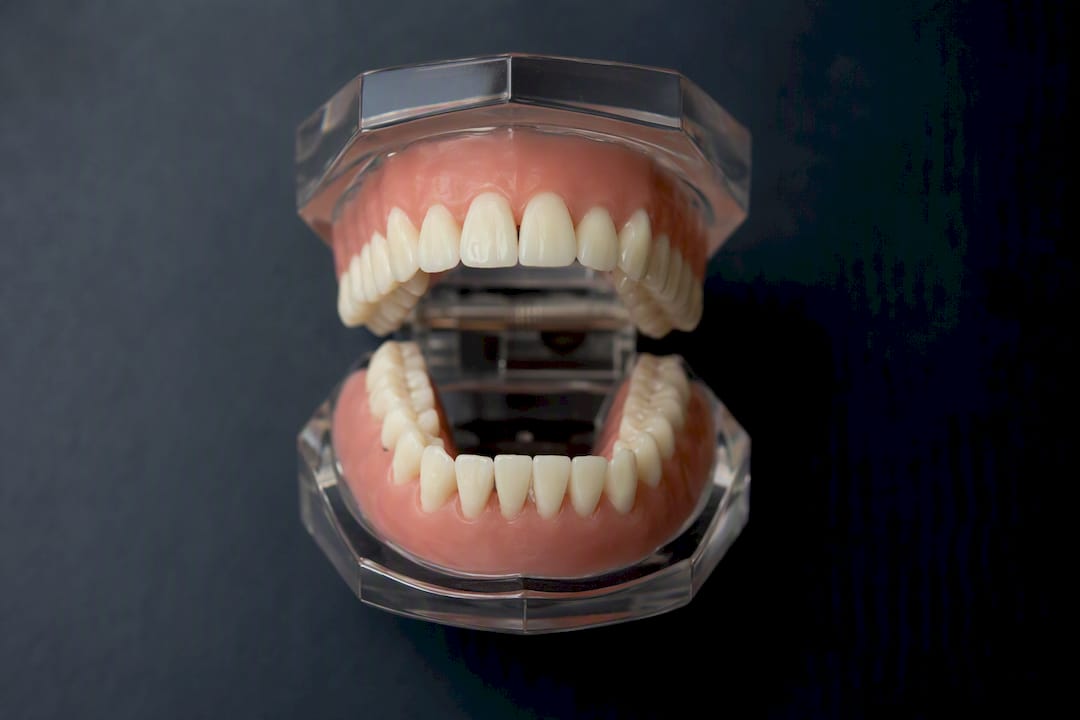
Open bites rarely have one single cause. Most cases sit at the intersection of tooth position, jaw growth, and behaviour, and untangling which factor dominates is the first real diagnostic step.
Dental contributors are the most treatable with aligners:
- Delayed or abnormal eruption of the front teeth
- Crowding that pushes incisors out of vertical alignment
- Tooth position issues left over from childhood orthodontics
Skeletal contributors are harder to correct without surgery:
- Vertical maxillary excess, where the upper jaw grows too far downward
- A hyperdivergent growth pattern, giving a longer, narrower face shape
- Reduced posterior vertical dimension relative to the front of the mouth
Functional causes often overlap with both of the above:
- Tongue thrust, where the tongue pushes against the front teeth during swallowing
- Prolonged thumb or finger sucking in childhood
- Mouth breathing linked to airway restriction, which trains the tongue into a low, forward resting position
Pro Tip: If a habit caused the open bite in the first place, correcting the teeth without addressing the habit is like straightening a fence post in soft ground. It won’t hold unless the underlying pressure stops.
Can Invisalign or clear aligners treat an open bite? A summary of the evidence
The short answer is yes for tooth-position cases, and the numbers back it up better than most people expect from a “cosmetic” treatment.
The meta-analysis pooling multiple studies found clear aligner therapy produced a statistically significant mean overbite correction of 2.76mm (95% CI: 2.23 to 3.28), with incisor extrusion identified as the main driver of that change. That’s a meaningful shift for a condition often measured in single millimetres.
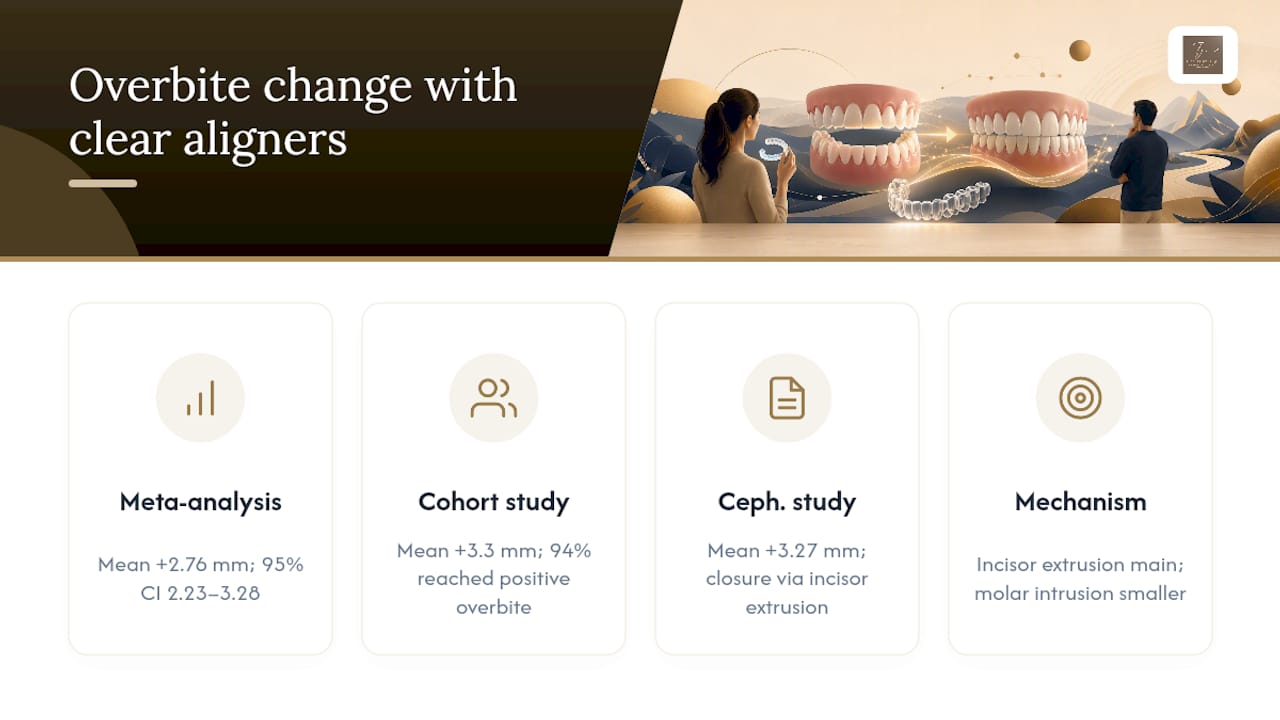
Individual studies tell a similar story with slightly larger numbers. A retrospective cohort of adults treated with non-extraction aligners reported a mean overbite change of 3.3mm (±1.4mm), with positive overbite achieved in 94% of patients over an average treatment period of around 1.5 years. A separate retrospective cephalometric study measured an average change of 3.27mm (±1.09mm), attributing the closure mainly to incisor extrusion with a smaller contribution from molar intrusion.
That last point is worth sitting with. Most of the correction comes from the front teeth extruding downward into contact, not from the back teeth being pushed up. Molar intrusion, the harder, more anatomically limited movement, contributes far less unless the plan specifically incorporates skeletal anchorage.
A 2024 clinical study on Invisalign specifically confirmed statistically significant overbite improvements, reinforcing that these results aren’t confined to generic aligner systems. What none of these studies claim, however, is that aligners work equally well across all severities. The evidence base is strongest for mild to moderate dental cases and considerably thinner for severe or skeletal presentations, where surgical or TAD-assisted approaches dominate the outcome data instead.
Who is the best candidate for aligner-based open-bite correction?
Not every open bite is an aligner case, and working out which category you fall into before booking a consultation saves time and sets realistic expectations.
- Dental open bite with normal jaw proportions. If your facial profile looks balanced and the gap is purely down to tooth position, you’re the ideal candidate. This is where the 2.7 to 3.3mm improvements cited above are most achievable.
- Mixed dental/skeletal cases with mild vertical excess. Still treatable, often with elastics or partial TAD support, but expect a longer timeline and possibly staged refinements.
- Skeletal open bite with significant vertical growth. Aligners alone rarely resolve these. A referral for combined orthodontic and surgical assessment is the honest recommendation here, not a promise that clear trays will do the job.
Getting the diagnosis right requires more than a mirror check. A proper work-up includes an intraoral exam, a cephalometric tracing to measure jaw relationships, and in more complex cases, 3D imaging such as CBCT to assess the skeletal pattern in full. Habit assessment matters too. If tongue thrust or mouth breathing is active, that gets flagged before any tray is fitted.
Beyond diagnosis, a few personal factors influence how well aligners perform: consistent wear (the single biggest variable), healthy gums and periodontal support, and, for growing patients, whether the jaw itself is still developing. Adults with settled growth and good compliance make up the strongest candidate group overall.
How aligners actually close an open bite: mechanics, planning and common auxiliaries
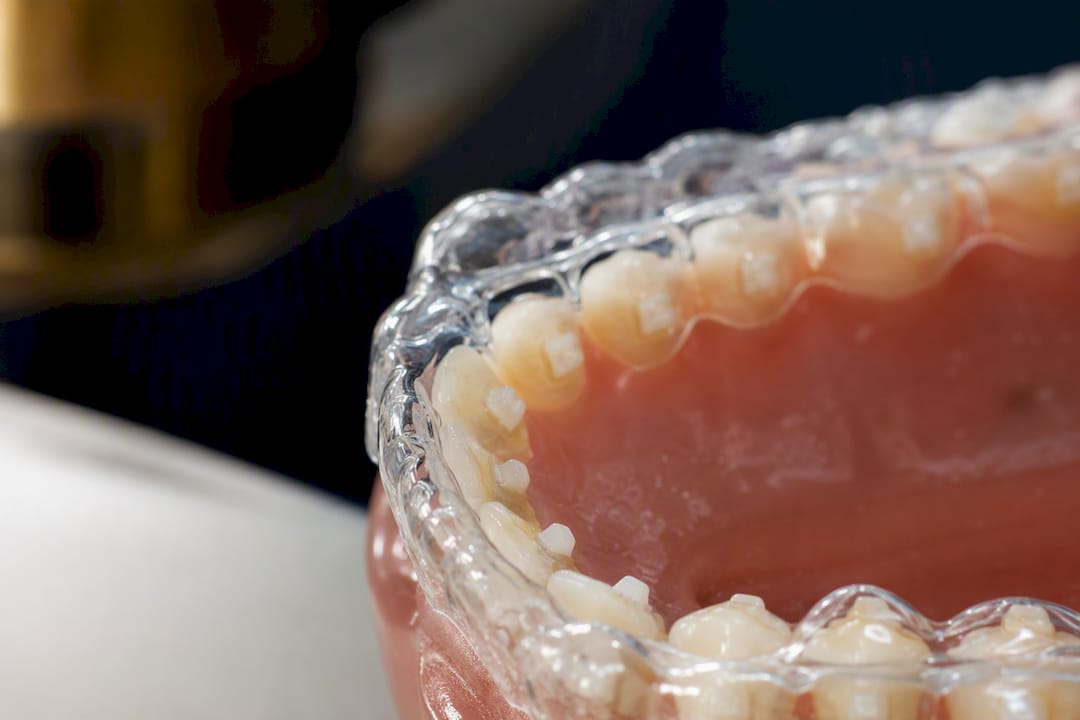
Every open bite case starts with digital planning software mapping out a projected sequence of tooth movements, visualised stage by stage before any tray is manufactured. It looks precise on screen. In practice, a 2024 scoping review found that digital planning software tends to overestimate how much vertical movement will actually happen, which is why refinement phases are the norm rather than the exception in these cases.
The mechanics themselves rely heavily on attachments, small tooth-coloured shapes bonded to specific teeth that give the aligner extra grip to push or pull in a particular direction. For open bite cases, clinicians typically use optimised attachment placement and staging protocols (sometimes referred to in G4-style systems) designed specifically for anterior extrusion, encouraging the front teeth to extrude into contact while trying to limit unwanted posterior movement.
Elastics often get added partway through treatment, small rubber bands running between upper and lower trays that help pull the bite into a more favourable vertical and horizontal relationship. Interproximal reduction, shaving tiny amounts of enamel between teeth, sometimes creates the space needed for repositioning without extraction. For cases needing genuine molar intrusion rather than just incisor extrusion, temporary anchorage devices, small titanium screws placed in the bone as a fixed anchor point, get combined with the aligner system to achieve the vertical control that trays alone can’t reliably deliver.
Pro Tip: If your treatment plan shows attachments only on your front teeth with no mention of elastics or refinement stages, ask why. Open bite cases almost always need more biomechanical support than a straightforward crowding case.
Treatment journey and timeline: from consultation to refinements
Open bite correction with aligners follows a fairly predictable arc, though the exact pace depends on severity and how disciplined you are with wear.
- Consultation and imaging. Expect an intraoral scan, photographs, and possibly a cephalometric X-ray to confirm whether your case is dental, skeletal, or mixed before any plan is finalised.
- Digital plan review. You’ll see a simulated before-and-after, though as noted above, treat the projected numbers as a guide rather than a guarantee.
- Active treatment. Trays change every one to two weeks, with attachments and possibly elastics introduced at set points. Wear time of 20 to 22 hours a day is non-negotiable here, since vertical tooth movement needs sustained, continuous force to work. Miss too many hours and the extrusion simply doesn’t happen at the predicted rate.
- Refinement phase. Because digital software over-predicts vertical movement, most open bite cases need at least one refinement scan partway through, essentially a reset and recalibration based on where the teeth actually are versus where the plan expected them to be.
- Monitoring and completion. Regular check-ins track overbite closure in millimetres, comparable to the 2.7 to 3.3mm ranges reported across the studies already discussed.
For adults, total treatment commonly runs around 1.5 years, though mild dental cases can finish faster and mixed cases with elastics or TADs often run longer. Anyone weighing up the full aligner process should plan for that refinement stage from day one rather than treating it as a setback.
When adjuncts or orthognathic surgery are required
Some open bites simply exceed what tooth movement alone can fix, and recognising the threshold early avoids months of aligner wear with disappointing results.
- TADs or mini-screws become necessary when the case needs reliable molar intrusion rather than just incisor extrusion, particularly where posterior teeth have over-erupted and are holding the bite open.
- Intermaxillary elastics get added when the bite relationship between upper and lower arches needs correcting alongside the vertical gap, not just the front tooth position.
- Orthognathic surgery becomes the realistic option for severe skeletal vertical excess, where facial proportions are affected and the open bite exceeds roughly 3 to 4mm with a clear skeletal component. No tray-based system reliably closes gaps of that scale when the underlying bone structure is the driver.
Adjuncts change the biomechanics fundamentally. A TAD gives the system a fixed point to pull against instead of relying on tooth-to-tooth anchorage, which is part of why intrusion becomes achievable at all once one is placed. Cases that combine aligners with these adjuncts tend to show more stable, more predictable vertical change than aligners used in isolation. Understanding where cosmetic dentistry and orthodontics diverge helps clarify why some open bite cases sit outside what any aligner system, however well planned, can achieve alone.
Stability and relapse prevention: retention and myofunctional therapy
Closing the gap is only half the job. Open bites have a reputation for relapsing, and the reason usually traces back to whatever caused the problem in the first place still being active after the trays come off.
- Tongue posture is the most common relapse driver. If the tongue still rests low and pushes forward at rest or during swallowing, it will gradually re-open the bite it took a year or more to close.
- Persistent habits, thumb sucking or mouth breathing left unaddressed, work against retention in the same way.
- Inadequate retention compounds both issues. Fixed retainers bonded behind the front teeth or removable retainers worn nightly are both used, with many clinicians recommending indefinite part-time wear for open bite cases specifically, given the relapse tendency.
Clinical guidance increasingly points to myofunctional therapy, targeted exercises retraining tongue posture and swallowing patterns, as a genuine stability aid rather than an optional extra, particularly where a tongue thrust habit was part of the original diagnosis.
Pro Tip: Ask your clinician whether your case involved a habit component before treatment. If it did, retention without habit correction is treating half the problem.
Why trust this advice: TJ Smile Studio’s approach to open-bite cases
TJ Smile Studio is a Glasgow-based cosmetic dentistry clinic led by Dr Tashfeen Jamil, built around a fully digital workflow that supports precise diagnosis and planning for cases like open bite correction.
That workflow matters for open bite specifically, given how much refinement and monitoring these cases typically need. Digital scanning allows:
- Accurate baseline measurement of overbite and bite relationships without physical impressions
- Clear visual communication of the proposed movement plan before treatment begins
- Faster turnaround on refinement scans when adjustments are needed partway through
Every plan starts with an honest assessment of whether a case is dental, skeletal, or a mix of both, since that distinction shapes everything that follows in Invisalign treatment planning.
What the evidence actually tells us about open bite treatment
The research is more encouraging than the conventional caution around open bites suggests. A pooled correction of 2.76mm might sound modest until you consider that most anterior open bites requiring treatment fall in the 1 to 4mm range. That’s not a marginal improvement. In many dental cases, it’s the difference between a gap and full contact.
Where the conventional advice falls short is in treating “open bite” as one category. Patients are often told aligners “can’t fix” open bites, based on outdated assumptions or cases that were skeletal from the start. The real distinction isn’t aligners versus surgery. It’s diagnosis versus guesswork. A dental open bite with good compliance behaves nothing like a skeletal one, and lumping them together does a disservice to people who are genuinely good candidates.
My priority for anyone reading this: get the cephalometric assessment before deciding aligners are or aren’t right for you. The millimetre-level data in this article only applies if the diagnosis matches the case. Skip that step, and you’re gambling with a year of treatment on an assumption rather than evidence.
— Tashfeen
Book an Invisalign assessment with TJ Smile Studio in Glasgow
If you’ve read this far wondering whether your own bite qualifies, the honest answer depends on details a photograph can’t capture, which is exactly what a proper assessment is for. TJ Smile Studio offers a fully digital consultation process, meaning your overbite, tooth position, and jaw relationship get mapped precisely from the first visit rather than estimated.
At your consultation, you can expect an intraoral scan, a clear discussion of whether your case is dental, skeletal, or mixed, and a realistic outline of what Invisalign treatment in Glasgow would involve for your specific gap, including whether elastics or additional support might be needed. For patients weighing up open bite correction alongside broader cosmetic goals, the clinic’s digital smile makeover service shows how aligner planning fits into a wider smile plan. Book a consultation to get your bite measured properly before deciding what treatment path makes sense.
Sources
- Efficacy of Clear Aligner Therapy for the Treatment of Anterior Open Bite in Adults: A Systematic Review and Meta‐Analysis
- Treatment of anterior open bites using non-extraction clear aligner therapy in adult patients
- Evaluation of open bite closure using clear aligners: a retrospective study
- Scoping review—The effectiveness of clear aligners in the management of anterior open bite in adult patients
This article is general information, not personal dental advice. What's right for your teeth depends on a clinical examination — the condition of your enamel, gums, bite and any existing dental work — and no article can assess that. Outcomes vary between patients, and all treatment at TJ Smile Studio is subject to assessment and clinical suitability.
Clinically reviewed by Dr Tashfeen Jamil BDS, MFDS RCS Ed, AssocFCGDent, PGDip Restorative and Aesthetic Dentistry — GDC registration 286427, Principal Dentist at TJ Smile Studio, 1 Spiersbridge Way, Thornliebank, Glasgow G46 8NG.
If you have dental pain, swelling or an injury, call the practice on 07728 808510. Out of hours in Scotland, call NHS 24 on 111.