
30 August 2026 · TJ Smile Studio
Invisalign Treatment Time: Most Adults Finish in 6–18 Months
Realistic Invisalign treatment timelines for adults, mapped to case complexity and month by month stages. Learn how 20 to 22 hours' daily wear,...
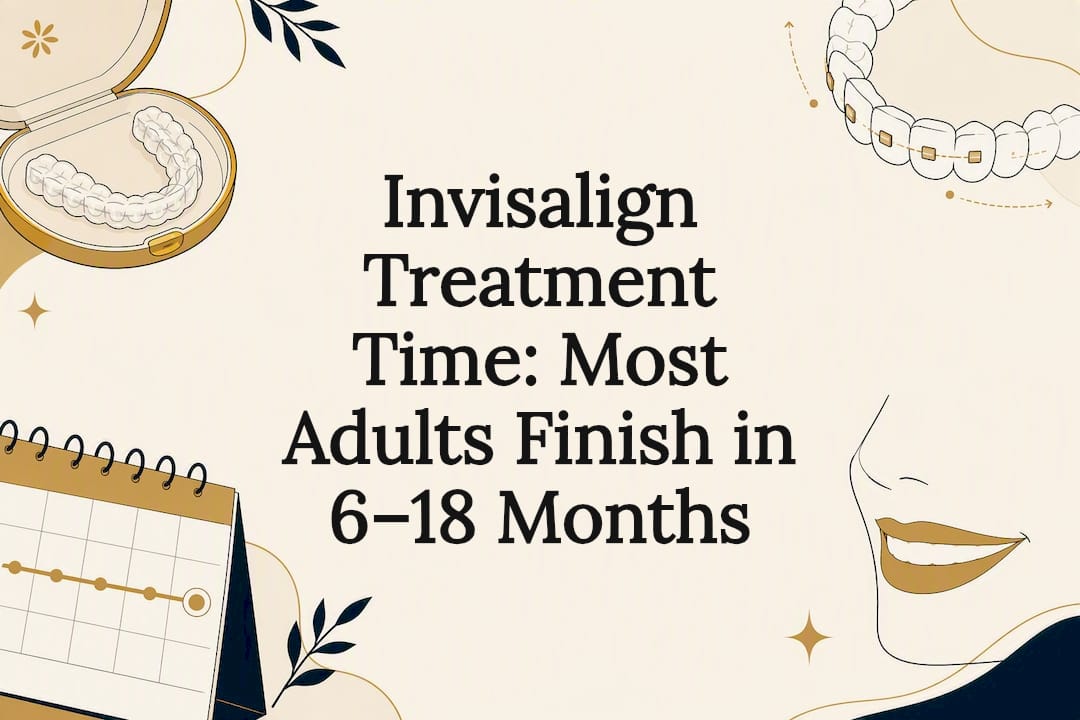
Most Invisalign treatments finish somewhere between 3 and 24 months, and the majority of adults land in the 6 to 18 month band. The single biggest variable within that range isn’t your bite or your budget. It’s whether you actually wear the aligners for 20 to 22 hours a day, because that number decides whether you finish on schedule or drift into extra months of refinements.
TL;DR:
- Wearing aligners fewer than 20 hours daily significantly extends treatment time and increases the likelihood of refinements.
- Mild cases often require 3 to 6 months, while moderate and complex cases can take 6 to 24 months based on severity and movement difficulty.
- Treatment length is influenced more by daily wear habits and case complexity than by the initial diagnosis or package tier.
- Most patients tend to under-wear their aligners, which can cause tracking failures and prolong the overall treatment.
- Refinements may add 4 to 12 weeks to the treatment, and retainer use is essential to prevent relapse after finishing aligner therapy.
Table of Contents
- Invisalign treatment time by case complexity
- The step-by-step Invisalign timeline, from scan to retainer
- What actually speeds up or slows down your treatment
- What the wear-time research actually shows
- Refinements and retainers: the part people forget to plan for
- A realistic month-by-month Invisalign timeline
- How Invisalign compliance shapes what patients actually experience
- Why I tell patients the timeline is a promise, not a guess
- Ready to get a realistic Invisalign timeline for your own smile?
- Where these figures come from
- Sources
- FAQ
Invisalign treatment time by case complexity
Ask any orthodontist what they hate most about giving timeline estimates, and they’ll tell you it’s the assumption that “Invisalign” means one fixed journey. It doesn’t. A single crooked incisor and a full bite correction with rotated canines are both technically “Invisalign cases,” but they sit at opposite ends of a very wide spectrum.
Mild cases typically take 3 to 6 months, occasionally stretching to 9. This covers minor crowding, small gaps, or a single tooth that’s rotated a few degrees. These cases often use fewer than 20 aligners and rarely need attachments (the small tooth-coloured bumps that give aligners extra grip). If you’re mainly chasing a straighter smile for photos rather than fixing a functional bite problem, this is likely your tier.
Moderate cases run 6 to 12 months. This is where most adult patients actually sit: noticeable crowding, moderate spacing, mild overbite or underbite correction, and movements that need a handful of attachments to execute properly. Expect somewhere between 20 and 40 aligners across the full series.
Complex cases take 12 to 24 months, sometimes longer. This tier includes significant bite correction, multiple rotated teeth, extrusions (pulling a tooth down into position), or cases where jaw relationship needs meaningful adjustment. UK clinic data consistently places these longer corrections in the 18 to 24 month range, sometimes edging past it when elastics or auxiliary appliances are involved.
Invisalign’s own product tiers roughly mirror this structure, which is worth knowing before your consultation:
- Invisalign Express (5 to 7 aligners): minor relapse correction or very small cosmetic tweaks, usually 3 months or less
- Invisalign Lite (up to 14 aligners): mild to moderate crowding or spacing, typically 4 to 6 months
- Invisalign Comprehensive (unlimited aligners within the treatment plan): moderate to complex cases needing bite correction, typically 12 to 24 months
The package name your dentist quotes is often a faster way to gauge your timeline than trying to self-diagnose from the mirror.
The step-by-step Invisalign timeline, from scan to retainer
Every Invisalign journey follows the same basic sequence regardless of duration. Knowing the stages in advance makes the whole thing far less abstract.
-
Consultation and suitability check. Your dentist examines your bite, checks gum and bone health, and confirms Invisalign is appropriate rather than a case needing traditional orthodontics. This appointment usually takes 30 to 45 minutes and often includes X-rays.
-
Digital scan with an iTero scanner. Instead of the old putty impressions, an iTero scanner captures a 3D model of your teeth in a few minutes. No mess, no gagging on trays, and the scan feeds directly into the planning software.
-
ClinCheck treatment planning. This is the digital blueprint. ClinCheck software maps every planned tooth movement from your current position to the final result, and your dentist reviews and adjusts it before manufacturing begins. Production of your first batch of aligners typically takes one to three weeks once the plan is approved.
-
First-fit and early adaptation. Your first aligners arrive, and this is where attachments get bonded on if your plan needs them. Expect two to three days of noticeable pressure and a slight lisp as your tongue adjusts. This settles quickly.
-
Active aligner phase. You move through the series on a cadence your dentist sets, commonly changing aligners every 7 to 14 days, with review appointments roughly every 6 to 10 weeks to check tracking and take new scans if needed.
-
End-of-series assessment. Once you’ve worn the final aligner in the planned sequence, your dentist checks whether teeth have tracked accurately. If they have, you move to retention. If not, this is where refinements get discussed.
What actually speeds up or slows down your treatment
Some of what controls your timeline is fixed the moment your ClinCheck plan gets approved. Some of it is entirely down to daily habits.
Wear time is the biggest lever you control. Invisalign is designed for full-time daily wear, leaving time for eating, drinking, and brushing. Fall short of prescribed wear time consistently and the digital plan may not match reality anymore.
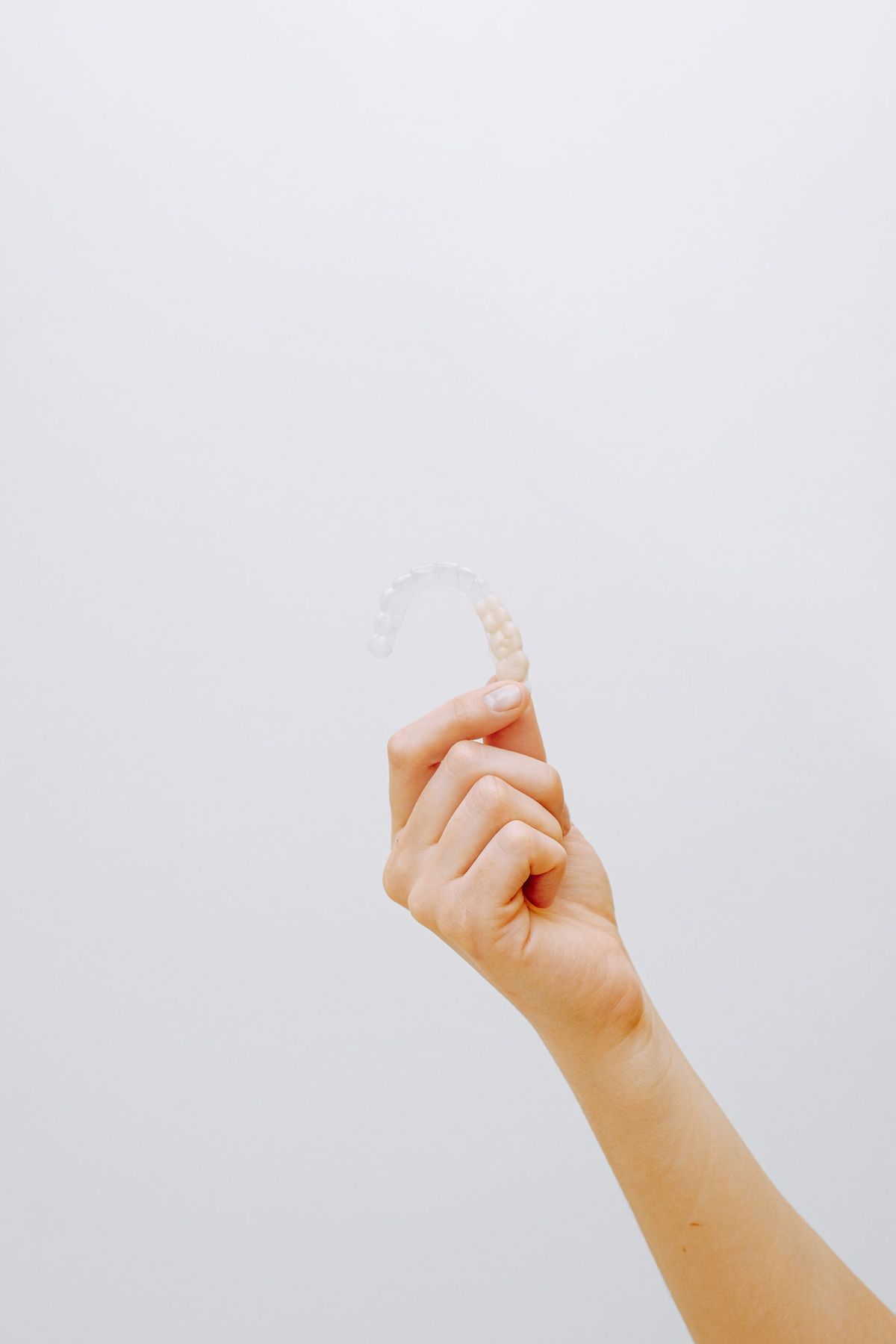
Case severity dictates how much room there is for error. A mild spacing case has some tolerance built in. A complex bite correction with elastics has almost none, because each aligner is doing more precise work.
Certain movements are just slower by nature. Rotating a rounded tooth like a canine, extruding a tooth downward, or shifting molars all take longer than simple tipping movements, regardless of how well you wear your aligners.
Attachments, interproximal reduction (IPR), and elastics all add planning complexity. These tools exist to make difficult movements possible at all, but they also mean more precise fit requirements and, occasionally, more review visits to check they’re doing their job.
- Bonded attachments improve aligner grip for rotations and extrusions
- IPR (tiny, controlled enamel reshaping between teeth) creates space without extraction
- Elastics assist bite correction but require strict wear compliance to work
Age and bone density have a measurable but modest effect compared with compliance. Bone remodels slightly slower in older adults, but the difference this makes to your finish date is dwarfed by how many hours a day you actually wear the trays.
Pro Tip: Ask your dentist whether your plan includes a review buffer. Most clinicians build 2 to 4 weeks of slack into each phase specifically to absorb minor wear-time shortfalls, so a few off days here and there won’t automatically push your entire finish date back.
What the wear-time research actually shows
Patients tend to overestimate how consistently they wear their aligners, and the objective data backs that up starkly. A randomised controlled trial using microsensors embedded in aligners found an overall mean wear time of 15.2 hours per day, several hours short of the 20 to 22 hour target. That gap, repeated daily across months, is exactly what pushes cases into refinement territory.
The same trial found something genuinely useful for anyone starting treatment: patients who knew their wear time was being objectively monitored wore their aligners substantially longer per day than those who didn’t. Simply being aware that compliance is measurable changes behaviour.
Objective microsensor data shows that awareness of monitoring can lift daily wear by more than four hours, turning a borderline non-compliant patient into one who comfortably clears the daily target.
15.2 hours was the average recorded wear time in that trial, against a prescribed 20 to 22 hours. That shortfall matters clinically, not just statistically. Sustained under-wear is directly linked to tracking failures, where teeth simply don’t reach the position the current aligner assumes they’re in. Once tracking slips, the next aligner in the series won’t seat properly, and the whole plan stalls until a refinement scan resets it.
The practical takeaway for anyone in active treatment: ask your dentist about compliance tracking, whether that’s a simple wear-time chart, a smart aligner feature, or just committing to honest self-reporting at each review. The data suggests the accountability alone does real work.
Refinements and retainers: the part people forget to plan for
Reaching your last planned aligner doesn’t always mean you’re finished.
Refinements typically add 4 to 12 weeks to your overall treatment time, depending on how much correction is needed. They’re triggered by tracking issues, minor relapse during the active phase, or simply a movement that needs finer tuning than the original plan captured. This isn’t a failure of treatment. It’s a normal part of how digital orthodontics works for a meaningful minority of cases.
Once your dentist confirms teeth have settled into their final position, retention begins. This is where Vivera retainers, Invisalign’s proprietary clear retainer material, typically come in. Most clinicians prescribe full-time wear for the first few months, then nights-only indefinitely.
- Ask your dentist upfront whether refinements are included in your treatment cost or billed separately
- Full-time wear compliance during the active phase is the strongest single predictor of avoiding a refinement
- Retainers aren’t optional extras. Skipping them risks relapse that can undo months of movement
A realistic month-by-month Invisalign timeline
Here’s roughly what a moderate case, the tier most adults fall into, looks like in practice.
-
Weeks 0 to 4: Consultation, iTero scan, and ClinCheck review happen in the first couple of weeks. Aligners are manufactured and fitted, and attachments go on if needed. By the end of week one wearing aligners, most people report the pressure has already eased and speech has normalised.
-
Months 1 to 3: This is where movement becomes visible, especially for crowding and spacing cases. You’ll likely have your first or second review appointment by month two, and this is when your dentist confirms early tracking is on target.
-
Months 3 to 6: A mid-treatment review typically happens here. For moderate cases, this is often the point where a dentist will flag whether a refinement looks likely, giving you advance warning rather than a surprise at the end.
-
Months 6 to 12+: For a moderate case, this is the finishing stretch, refinements if needed, then retainer fitting. Complex cases are often only at their midpoint here, with several more months of active movement ahead.
At each checkpoint appointment, it’s worth asking your dentist three things: are my teeth tracking as planned, am I on schedule for the original ClinCheck timeline, and is there anything in my wear routine I should adjust before the next review. Those three questions catch most problems early enough to fix them without adding weeks.
How Invisalign compliance shapes what patients actually experience
Traditional braces don’t ask anything of the patient day to day, which is precisely why comparing average timelines side by side can be misleading. Braces are usually quoted at 18 to 24 months regardless of how compliant the patient is, because there’s no daily wear decision to make. Invisalign’s headline range starts lower, often 6 to 18 months, but that range only holds if daily wear stays close to the prescribed 20 to 22 hours.
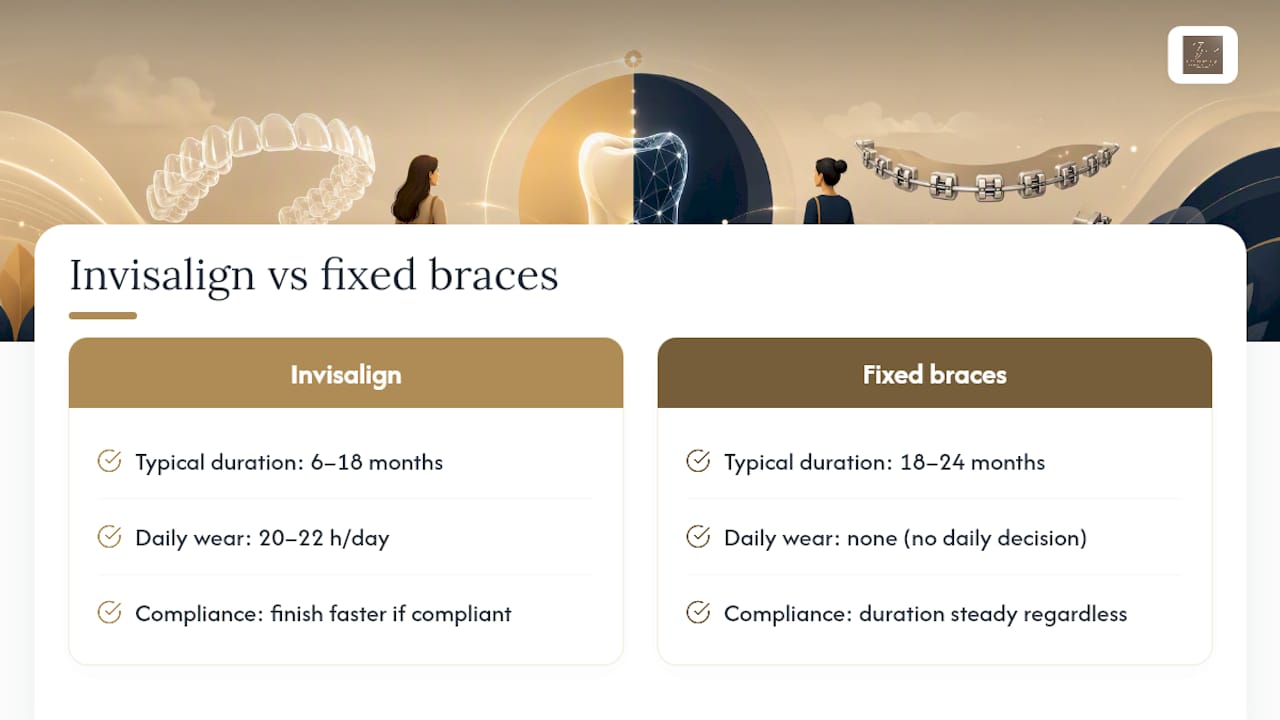
In practice, this means a well-organised patient with a moderate case can often finish faster with Invisalign than they would with fixed braces. A patient who removes their aligners too often, for meals, sport, or simply forgetting, can end up taking longer than braces would have, purely because of accumulated tracking failures and refinements. The technology gives you the option to finish faster. It doesn’t guarantee it.
Why I tell patients the timeline is a promise, not a guess
Every ClinCheck plan we run at TJ Smile Studio is a specific, numbered sequence of tooth movements, not a vague estimate. As a GDC-registered dentist, I take that precision seriously: when I quote a timeline, it’s built from the same digital plan that will govern every review appointment after it. Our fully digital workflow, from iTero scan through to final retainer, removes most of the guesswork that used to make orthodontic timing feel like a shrug.
That said, Invisalign isn’t always the right tool. When a patient wants an immediate cosmetic change rather than gradual movement, I’ll say so plainly and discuss alternatives like veneers instead of forcing a fit that doesn’t suit their goals.
— Dr Tashfeen Jamil BDS, MFDS RCS Ed, AssocFCGDent - GDC 286427
Ready to get a realistic Invisalign timeline for your own smile?
TJ Smile Studio runs Invisalign through the same digital workflow described throughout this article, iTero scanning, a personally reviewed ClinCheck plan, and Vivera retainers at the finish line, so the timeline you’re quoted at your consultation is built on your actual scan, not a generic estimate pulled from a brochure.
A typical consultation at our Glasgow clinic includes a full suitability check, a same-visit iTero scan where appropriate, and an honest conversation about which tier, Express, Lite, or Comprehensive, actually fits your case. We’ll tell you if your case looks like a 4 month job or a 16 month one, and why, before you commit to anything. If cosmetic results matter as much as alignment, we can also walk you through how Invisalign compares with a digital smile makeover for your specific goals. Book a consultation through our Invisalign service page to get a scan-based timeline instead of a guess.
Where these figures come from
The wear-time and monitoring figures cited above come from a randomised controlled trial using microsensors published in peer-reviewed orthodontic literature, alongside a related analysis of tracking failures linked to reduced wear. Digital workflow details reflect Invisalign’s own manufacturer description of iTero, ClinCheck, and Vivera. For clinician verification, check the General Dental Council register directly.
This article is general information, not a substitute for advice from a qualified doctor. Consult a qualified healthcare professional about your own circumstances before acting on anything here.
Sources
- Objective assessment of wear time during orthodontic aligner therapy using microsensors: A randomized controlled trial
- How does the Invisalign treatment work? | Invisalign
- Objective assessment of wear time during orthodontic aligner therapy using microsensors (ScienceDirect excerpt)
FAQ
What is the 30 minute rule with Invisalign?
It refers to keeping aligners in for at least 30 minutes after eating or drinking anything other than water, giving your teeth and the aligner material time to settle before you reinsert them, which helps maintain accurate fit.
How long is a normal Invisalign treatment?
Most adults complete treatment in 6 to 18 months, with mild cases finishing in as little as 3 to 6 months and complex bite corrections sometimes extending to 24 months.
Can Invisalign move teeth in 2 days?
No. Each aligner typically stays in place for 7 to 14 days to allow gradual, controlled movement, and forcing faster changes risks poor tracking and discomfort rather than faster results.
How long do 20 trays of Invisalign last?
At a typical change cadence of 7 to 14 days per aligner, 20 trays generally take between about 4 and 7 months to complete, depending on the schedule your dentist sets.
Recommended
This article is general information, not personal dental advice. What’s right for your teeth depends on a clinical examination — the condition of your enamel, gums, bite and any existing dental work — and no article can assess that. Outcomes vary between patients, and all treatment at TJ Smile Studio is subject to assessment and clinical suitability.
- Dr Tashfeen Jamil BDS, MFDS RCS Ed, AssocFCGDent, PGDip Restorative and Aesthetic Dentistry — GDC registration 286427
This article is general information, not personal dental advice. What's right for your teeth depends on a clinical examination — the condition of your enamel, gums, bite and any existing dental work — and no article can assess that. Outcomes vary between patients, and all treatment at TJ Smile Studio is subject to assessment and clinical suitability.
Clinically reviewed by Dr Tashfeen Jamil BDS, MFDS RCS Ed, AssocFCGDent, PGDip Restorative and Aesthetic Dentistry — GDC registration 286427, Principal Dentist at TJ Smile Studio, 1 Spiersbridge Way, Thornliebank, Glasgow G46 8NG.
If you have dental pain, swelling or an injury, call the practice on 07728 808510. Out of hours in Scotland, call NHS 24 on 111.