
01 September 2026 · TJ Smile Studio
1.3–1.79 mm Overbite Reduction With Invisalign Deep Bite: Real Results
Invisalign for deep bites: clinic and research perspective. Expect roughly 1.3–1.79 mm overbite change, key limits, and when braces or a hybrid approach...
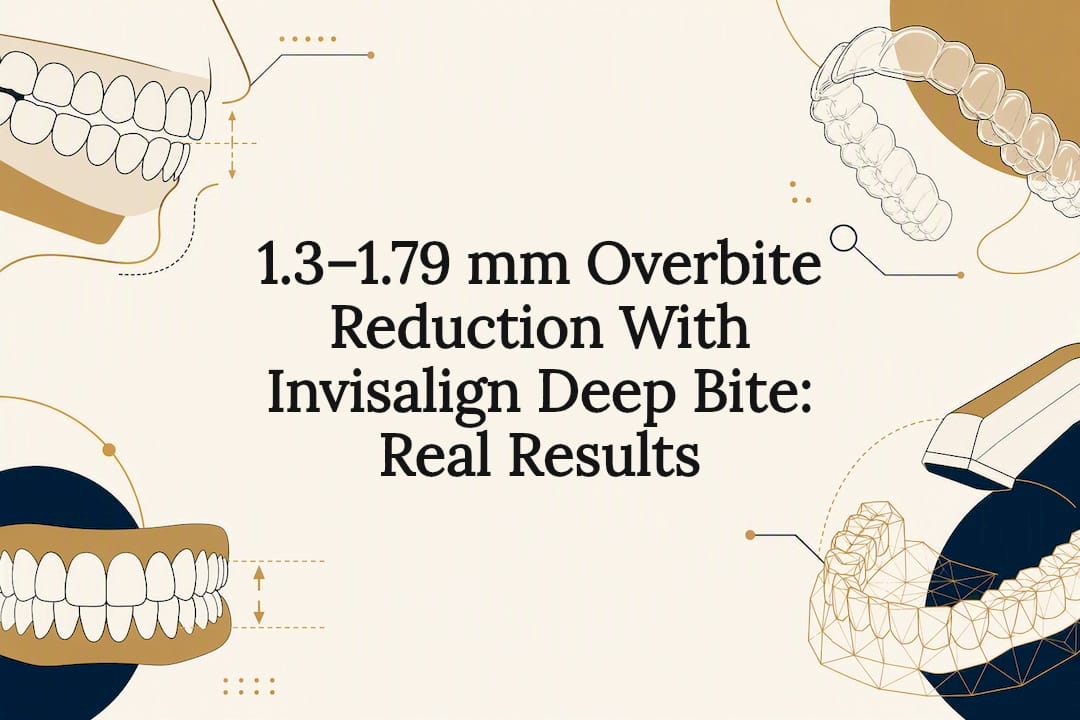
Invisalign can correct many mild-to-moderate deep bites, typically reducing overbite by 1.3 to 1.79 millimetres using bite ramps and calculated tooth movement rather than surgery. It struggles with severe or skeletally-driven cases, where fixed appliances still achieve larger, more predictable change. The sections below explain the biomechanics, the evidence, and how a clinician decides which path suits you.
TL;DR:
- Invisalign typically achieves a deep bite reduction of about 1.3 to 1.79 millimeters, but actual results often reach only 38% to 51% of the planned correction.
- Proper inclusion of bite ramps and attachment placement in the treatment plan can improve intrusion outcomes, especially when used with frog staging and overcorrection techniques.
- Severe or skeletal deep bites usually require fixed appliances or hybrid approaches, as aligners alone may not reliably deliver larger corrections beyond approximately 3 millimeters.
- The majority of bite correction occurs during the initial aligner stage, with refinements adding limited improvement, emphasizing the importance of accurate planning upfront.
- Risks such as root resorption and tracking failure are manageable but require careful monitoring, especially during intrusive movements and in darker cases with skeletal components.
Table of Contents
- How Invisalign corrects a deep bite: bite ramps, attachments, and intrusion
- What the research shows: typical results, predictability, and limitations
- Who is a good candidate for Invisalign deep bite correction?
- Treatment pathway and timeline: what to expect from scan to refinements
- When to consider fixed appliances or a hybrid approach
- Realistic before-and-after expectations and combining restorative work
- Clinical perspective from Dr Tashfeen Jamil and TJ Smile Studio
- Expected comfort and pain levels during treatment relevant to deep bite correction
- Potential risks and complications specific to deep bite treatment with Invisalign
- Maintenance and care tips for aligners during deep bite treatment
- Post-treatment retention strategies to maintain deep bite correction
- A short first-person perspective on realistic goals and shared decision-making
- TJ Smile Studio: Invisalign services and how to book a consultation
- Sources
- FAQ
How Invisalign corrects a deep bite: bite ramps, attachments, and intrusion
A deep bite means your upper front teeth cover too much of your lower front teeth when you bite together, usually more than 3 to 4 millimetres of vertical overlap. Correcting it means moving teeth vertically, not just side to side, and that’s mechanically harder for aligners than closing a gap or straightening a crooked incisor.
Three movements do the work. Intrusion pushes a tooth up into the bone, shortening how far it protrudes below the gumline. Extrusion pulls a tooth down, usually on back teeth, to open space at the front. Proclination tips the front teeth forward slightly, which can also reduce vertical overlap without any actual intrusion at all. Most Invisalign deep bite plans use a mix of the three, weighted according to the case.
Precision bite ramps are the signature G5 feature for this problem. They’re small ridges bonded to the inside surface of the upper front teeth that make the lower teeth hit a raised platform instead of the upper tooth edges. This disoccludes, or slightly separates, the back teeth, which removes the biting force that would otherwise stop the posterior teeth from erupting further. ClinCheck software tends to trigger bite ramps automatically once planned lower incisor intrusion passes roughly 1.5 millimetres, so it’s worth asking your clinician directly whether your plan includes them rather than assuming it does.
SmartForce attachments, the small tooth-coloured tabs bonded to specific teeth, give the aligner plastic something to grip so it can apply a genuine intrusive or extrusive force rather than just sliding over the tooth surface. Clinical data suggests bite ramps, when properly triggered in ClinCheck, can improve lower incisor intrusion by up to 30% compared with aligners lacking them.
Staging matters as much as the hardware. A technique orthodontists call frog staging, where lower premolars are extruded early to create a stable platform, and deliberate overcorrection built into the ClinCheck plan both improve the predictability of bite opening by giving the aligner a firmer anchor to push against.
Aligner plastic has real limits here. It flexes under sustained vertical load in a way that rigid archwire doesn’t, so vertical movements express less reliably than horizontal ones. That’s the honest reason predictability numbers for deep bite correction sit lower than for crowding or spacing cases.
Common tools in a deep-bite ClinCheck plan:
- Precision bite ramps to disocclude posterior teeth and unlock vertical space
- SmartForce attachments for incisor intrusion and molar extrusion
- Frog staging of lower premolars to create anchorage
- Built-in overcorrection to compensate for incomplete expression
- Interproximal reduction where crowding limits proclination options
Pro Tip: Ask to see your ClinCheck simulation with the bite ramps visible and ask your clinician to point out exactly which stages introduce intrusion. If the answer is vague, the plan probably hasn’t been tailored to your bite specifically.
What the research shows: typical results, predictability, and limitations
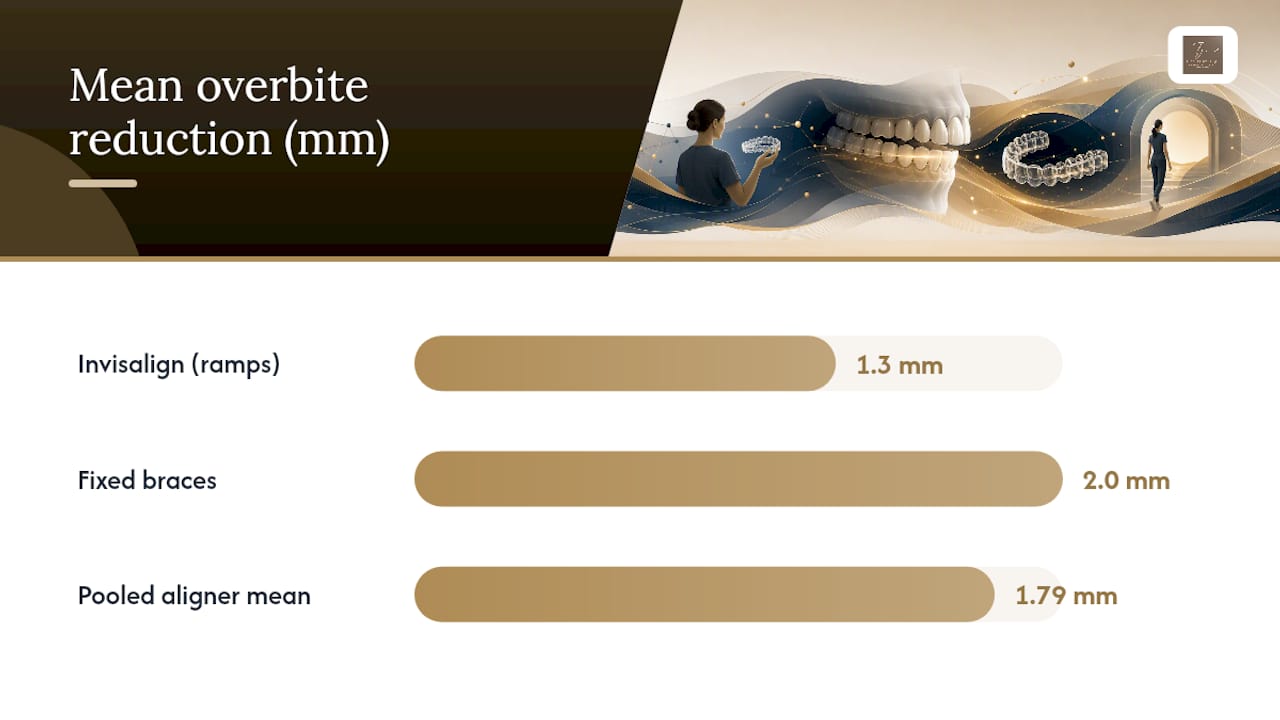
Contemporary clear-aligner studies report a pooled mean overbite reduction of about 1.79 millimetres, with planned correction typically expressed at roughly 38% to 51% depending on case severity.
That gap between “planned” and “expressed” is the single most important number in this article. If your ClinCheck plan calls for 3 millimetres of overbite reduction, research suggests you might reasonably end up with somewhere between 1.1 and 1.5 millimetres of it actually happening, not the full amount. A 2026 systematic review and meta-analysis pooling contemporary clear-aligner data found that mean reduction of 1.79 mm, alongside enormous variability between studies (a heterogeneity statistic, I², of 96.3%, essentially confirming that individual case results scatter widely around that average).
A graduate clinical thesis examining adult Invisalign cases found overbite reduction in the 1.3 to 1.79 mm range, with correction accuracy ranging from roughly 38.54% to 51.35% depending on how deep the bite was to start with. Deeper starting bites tend to show lower percentage accuracy, not higher, because the biomechanical demands increase faster than the aligner’s capacity to deliver them.
How does that stack up against braces? A 2021 cephalometric case series comparing Invisalign with precision bite ramps against fixed appliances in adults found Invisalign achieved a mean overbite reduction of about 1.3 mm, while fixed appliances in the same cohort achieved around 2.0 mm. Fixed appliances also produced a smaller increase in mandibular plane angle, a cephalometric marker relevant when a case has a skeletal component. The takeaway isn’t that Invisalign underperforms categorically. It’s that braces still have an edge specifically when the correction needed is larger or the case has a skeletal driver.
A separate 2024 retrospective CBCT study muddies that picture usefully. It found that skeletal deep overbite correction with Invisalign, whether bite ramps were used or not, was comparable to fixed appliances on several measurements. This suggests the aligner-versus-braces gap isn’t uniform. It depends heavily on which outcome you’re measuring and how the case was staged.
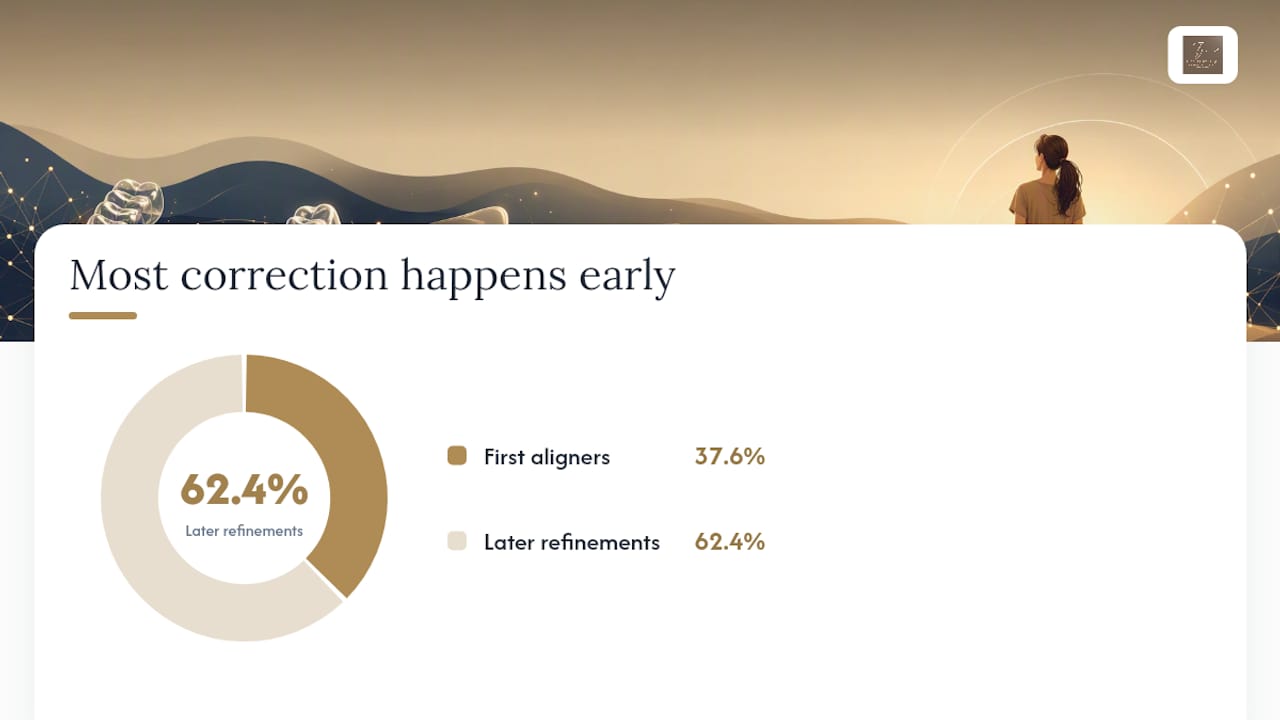
Timing matters too. A 2024 retrospective study on aligner refinements found mean correction accuracy after the very first set of aligners sat around 37.6%, and that completed cases, even after multiple rounds of refinement, averaged only about 38.5% of the originally planned overbite correction. In plain terms: refinements rarely rescue a deep bite case that didn’t respond well the first time round.
Why do outcomes vary so much between studies and patients? A few consistent factors keep showing up:
- Case mix: studies pooling mild and severe deep bites together will always show wider scatter than studies of a single severity band
- Staging design: plans using frog staging and deliberate overcorrection tend to express closer to the planned figure
- Wear compliance: aligners only move teeth while they’re in the mouth, and intrusion is particularly sensitive to missed hours
- Attachment and ramp placement: not every plan uses precision bite ramps even when they’d help, which skews pooled averages downward
None of this makes Invisalign a poor option for deep bites. It makes it a treatment where the numbers deserve a proper conversation before you commit, not a glance at a marketing photo.
Who is a good candidate for Invisalign deep bite correction?
The single biggest factor in whether Invisalign alone will fix your bite is whether the problem sits in the teeth or in the jaw bones underneath them.
A dental deep bite happens when the front teeth have simply over-erupted relative to a jaw structure that’s basically normal. This is the scenario aligners handle well, because intrusion and extrusion are dentoalveolar movements, meaning they reposition teeth within the bone rather than reshaping the bone itself. A skeletal deep bite involves the underlying jaw relationship, often a short lower face height or an overclosed bite pattern baked into the bone structure. Aligners can’t change that, and neither can braces without additional intervention.
Clinicians generally look for a combination of signs before recommending Invisalign alone for a deep bite case:
- Overbite depth: cases under roughly 5 to 6 millimetres of vertical overlap respond more predictably; beyond that threshold, the required expression starts exceeding what aligner plastic reliably delivers
- Facial pattern: a normal or slightly reduced lower face height is favourable; a markedly short lower face height signals a skeletal component
- Periodontal health: intrusion puts sustained load through the periodontal ligament, so active gum disease needs treating first
- Tooth wear and restorative needs: heavily worn front teeth may need bonding or veneers after orthodontic correction, and that sequencing decision is worth having early, not as an afterthought
- Age and growth status: adults have finished growing, so treatment relies entirely on tooth movement rather than any growth guidance that’s available in younger patients
If several of those point away from a straightforward dental case, that’s not a reason to rule out Invisalign entirely. It’s a reason to have your clinician show you exactly which ClinCheck triggers, bite ramps, specific attachment placement, staged extrusion, are built into your plan and why. A clinician experienced with Invisalign treatment for deep bites should be able to point to those features specifically, not describe the plan in generalities.
Treatment pathway and timeline: what to expect from scan to refinements
Treatment starts with a digital scan, which feeds into a ClinCheck simulation showing your teeth moving stage by stage towards the planned outcome. For deep bite cases specifically, this simulation is worth scrutinising rather than skimming, because it’s where bite ramps, attachment placement, and staging sequence all become visible before a single aligner is manufactured.
Overall duration varies with complexity. Mild dental deep bites might resolve in a similar timeframe to routine aligner cases, while cases needing significant intrusion or combined with crowding or spacing issues run longer. What’s consistent across the research is where the correction actually happens.
Roughly 37.6% of planned overbite correction is achieved during the first set of aligners alone, with further refinement rounds adding comparatively little on top of that.
That single figure should reset expectations around refinements. If your bite hasn’t opened meaningfully by the end of the initial series, ordering another round of aligners rarely closes the gap on its own. It usually signals the plan needs rethinking, more bite ramps, different staging, added attachments, rather than simply “more time.”
During treatment, your clinician should be monitoring for tracking problems: aligners that no longer seat fully, visible gaps between the aligner edge and the gumline, or teeth that haven’t followed the predicted path by the scheduled check-in. Any of these can prompt a mid-course scan and a revised plan before the case drifts too far from target.
Because intrusion places sustained force through the tooth root, monitoring also matters from a safety perspective:
- Periodic clinical checks for tenderness, mobility, or gum recession around teeth undergoing active intrusion
- Radiographic review if any signs of root resorption appear, more likely with heavier intrusive forces over longer periods
- Comparative reassurance from the evidence: aligners have shown significantly less reduction in root length than fixed appliances in at least one CBCT study, though monitoring still matters for any patient undergoing active intrusion
- Compliance checks, since missed wear time disproportionately affects vertical movements compared with simple rotations or tipping
None of this is unusual for orthodontic treatment generally. It’s simply more relevant in deep bite cases because the movements involved carry a slightly higher biological cost than straightforward alignment.
When to consider fixed appliances or a hybrid approach
Some deep bites genuinely need more than aligners can deliver on their own, and a good clinician will say so rather than force a case into a ClinCheck plan that’s unlikely to succeed.
Hybrid approaches blend the aesthetics of aligners with the mechanical certainty of fixed components where it counts most. Options include using aligners for the majority of tooth movement while adding sectional fixed appliances just on the segments needing intrusion, or incorporating temporary anchorage devices (TADs), small titanium screws anchored temporarily in the bone, to provide a fixed point against which intrusive force can act more predictably than aligner plastic alone allows.
A few clinical signs tend to push a case towards fixed appliances or a hybrid plan rather than aligners alone:
- A skeletal deep bite with a genuinely short lower face height, where dentoalveolar movement won’t address the underlying pattern
- A need for more than roughly 3 millimetres of predictable overbite reduction, beyond what aligner-only mechanics reliably achieve
- Significant crowding or rotations combined with the deep bite, which can slow aligner tracking further
- Previous aligner treatment that failed to track or express planned intrusion adequately
The trade-off is straightforward to state, if not always easy to accept. Fixed appliances and TAD-assisted mechanics tend to win on predictability and on delivering larger corrections reliably, particularly in adults with skeletal involvement. Aligners win on aesthetics, comfort, and the ability to remove them for eating and cleaning. Neither is objectively superior, they solve for different priorities, and the right answer depends on how much the visible metalwork matters to you versus how much predictability you need from the outcome itself.
Realistic before-and-after expectations and combining restorative work
Before-and-after photos of deep bite correction can be genuinely misleading if you don’t know what you’re looking at. Mild cases, where the starting overbite was modest and mostly dental in origin, tend to show a clean, convincing improvement with the lower incisors now visible where they were previously hidden. Moderate cases usually show real but partial improvement, often paired with straighter, better-aligned front teeth even where the vertical change itself is modest. Borderline severe cases sometimes show good alignment with only a slight reduction in bite depth, which is an honest result but not always what the “after” photo implies at a glance.
A few things worth checking before trusting any set of photos:
- Ask whether the photos show the same lighting, camera angle, and lip position in both frames, since a relaxed smile versus a forced one changes how much overbite is visible
- Ask whether the case shown is dental or skeletal in origin, since that context changes what result is realistic for your own bite
- Ask how many refinement rounds it took, since a result achieved after three refinements sets a different expectation than one achieved after the first set
Restorative work often belongs in the plan too, particularly where a deep bite has caused visible wear on the lower front teeth over years of the upper teeth grinding against them. Sequencing matters here: orthodontic movement should generally finish, or at least stabilise, before composite bonding or veneers reshape worn edges, since moving a tooth after it’s been restored can distort the restoration.
Pro Tip: If your front teeth show visible flattening or shortening from years of deep bite wear, ask your clinician whether bonding should happen during treatment or only once your bite has fully settled. Doing it in the wrong order means redoing the restorative work later.
Clinical perspective from Dr Tashfeen Jamil and TJ Smile Studio
Assessing a deep bite properly means looking past the smile line to the underlying skeletal pattern, something a five-minute look in a mirror simply can’t tell you. Dr Tashfeen Jamil BDS, MFDS RCS Ed, AssocFCGDent, registered with the General Dental Council under number 286427, built TJ Smile Studio’s Invisalign workflow around a digital scan and ClinCheck review before any commitment is made, so patients see their own projected movement rather than a generic promise.
A deep bite assessment at TJ Smile Studio typically works through the same core questions covered in this article: is the overbite dental or skeletal in origin, how deep is the overlap, is periodontal health stable enough to support intrusion, and does the case need bite ramps, attachments, or staged extrusion to have a realistic chance of expressing the planned correction. Where a case looks borderline for aligners alone, that gets discussed openly rather than glossed over in the sales conversation.
Every plan is built from the patient’s own scan data rather than a templated protocol, which matters most in deep bite cases precisely because the research shows how much outcomes vary between individuals. A short consultation, done properly, should leave you with a specific answer about your own bite, not a general statement about what Invisalign can do.
Expected comfort and pain levels during treatment relevant to deep bite correction
Deep bite correction tends to feel different from routine aligner treatment, mainly because intrusion and bite ramps change how your teeth meet when you bite down. Expect noticeable pressure for the first two to three days after each new aligner, particularly around the front teeth undergoing intrusion, followed by a return to baseline comfort until the next change.
Bite ramps specifically create an odd early sensation many patients describe as their bite feeling “propped open” at the front, since the back teeth no longer touch fully. This resolves as you adjust, usually within the first week of wearing ramps, but it’s worth knowing in advance so it doesn’t feel like something has gone wrong.
Compared with fixed braces, most patients find aligners more comfortable day-to-day, since there’s no metal bracket rubbing against the inside of the cheek. The trade-off is that the discomfort you do feel during a deep bite case is often more concentrated, sharper pressure on specific teeth during intrusion rather than the general soreness braces cause across the whole arch. Over the counter pain relief and sticking to softer foods for the first couple of days after each aligner change usually manages this without difficulty.
If discomfort persists well beyond the usual few days, or if you notice a tooth feels loose rather than simply sore, that’s worth flagging to your clinician promptly rather than waiting for your next scheduled check.
Potential risks and complications specific to deep bite treatment with Invisalign
Intrusive movement carries a specific risk profile that simpler aligner cases don’t. The main concern is root resorption, a shortening of the tooth root that can occur when sustained intrusive force is applied over time. The comparative evidence here is genuinely reassuring: a CBCT study comparing techniques found significantly less root length reduction with Invisalign than with fixed appliances, though the risk isn’t zero for either approach.
Bite ramps and disocclusion of the back teeth can also cause temporary changes in how the jaw joint feels, particularly in patients who already have some temporomandibular joint sensitivity. This usually settles as the bite adjusts, but it’s a reasonable thing to mention at your initial consultation if you have a history of jaw joint issues.
Poor tracking is a more mundane but common complication in deep bite cases specifically, because vertical movements are less forgiving of missed wear time than horizontal ones. An aligner that isn’t seating properly around teeth undergoing intrusion won’t just fail to progress, it can occasionally move adjacent teeth in unplanned directions if left unaddressed for too long.
Gum recession around heavily intruded teeth is worth monitoring too, particularly in patients with naturally thin gum tissue. None of these risks are unique to Invisalign, fixed appliances carry comparable or larger versions of most of them, but a clinician planning a deep bite case should discuss all of this upfront rather than after treatment has started.
Maintenance and care tips for aligners during deep bite treatment
Deep bite cases put more riding on consistent wear than most other aligner treatments, since intrusion is one of the movements most sensitive to interrupted force. The standard guidance of 20 to 22 hours a day matters more here than in a simple spacing case, because falling short repeatedly can stall vertical movement almost entirely while horizontal movements continue relatively unaffected.
Bite ramps need particular care during cleaning. Food debris can collect around the ramp surface more easily than on a flat aligner edge, so a quick rinse and brush of both the aligner and the ramp area after eating helps avoid staining and odour building up over the weeks that ramp stays in use.
A few practical habits make a real difference over a deep bite course of treatment:
- Remove aligners only for eating, drinking anything other than water, and cleaning, to protect that 20 to 22 hour target
- Clean aligners with a soft brush and lukewarm water rather than hot water, which can warp the plastic around delicate bite ramp geometry
- Keep the aligner case with you rather than wrapping aligners in tissue, since misplaced trays mid-treatment can set intrusion progress back by weeks
- Attend every scheduled check so your clinician can catch tracking issues around bite ramps or intruded teeth early
Because so much of the total correction happens in the first set of aligners, consistent wear in those opening weeks arguably matters more in a deep bite case than at any later stage of treatment.
Post-treatment retention strategies to maintain deep bite correction
Deep bites have a documented tendency to relapse, teeth drifting back towards their original position, if retention isn’t taken seriously once active treatment ends. This isn’t unique to Invisalign; it applies to any orthodontic correction of vertical overlap, but it’s worth stating plainly because deep bite relapse can undo months of intrusion relatively quickly if retainers are skipped.
A clear retainer worn nightly is the standard approach after deep bite correction, and most clinicians recommend indefinite part-time wear rather than a fixed few months, given how strongly vertical corrections tend to want to return to their original position. Some cases also use a fixed retainer, a thin wire bonded behind the front teeth, particularly where intrusion was substantial.
Beyond the retainer itself, periodic review appointments in the first year after treatment let your clinician catch early signs of relapse while they’re still easy to correct with minor adjustments, rather than waiting until a noticeable regression has set in. If wear on the front teeth was part of the original picture, any restorative bonding done after treatment also benefits from that stability check first, since building up worn edges on teeth that are still settling can mean redoing the work.
A short first-person perspective on realistic goals and shared decision-making
Most people come in wanting one of two things: a straighter smile, or relief from the wear their deep bite has caused on the front teeth. Both are entirely reasonable goals, and Invisalign can often deliver meaningful progress on both. Where the conversation gets honest is admitting that “meaningful progress” and “full correction” aren’t always the same thing, particularly in cases with any skeletal component.
I’d rather tell a patient upfront that their case might land closer to 40% of planned correction than promise 100% and explain the shortfall later. The research supports that caution, and patients generally respond well to it, because it lets them make an informed choice rather than a hopeful one. A good assessment weighs function, how your bite actually meets, alongside how it looks, and any clinician who skips the functional half of that conversation isn’t giving you the full picture.
— Dr Tashfeen Jamil BDS, MFDS RCS Ed, AssocFCGDent - GDC 286427
TJ Smile Studio: Invisalign services and how to book a consultation
Getting a straight answer about your own deep bite means starting from your own scan data, not a generic percentage pulled from a study. TJ Smile Studio’s Invisalign service in Glasgow is built around exactly that: a digital intraoral scan, a ClinCheck simulation you review together with your clinician, and an honest conversation about whether bite ramps, staged extrusion, or a hybrid approach fit your case best before you commit to anything.
Your first appointment covers the scan itself, a walkthrough of your projected tooth movement stage by stage, and a clear discussion of cost and finance options for your specific plan, no vague ranges, no pressure to decide on the spot. Where restorative finishing might complement the orthodontic result, that gets flagged early too, so sequencing is planned rather than improvised later. If you’ve been putting off asking whether your bite qualifies, book a consultation through TJ Smile Studio’s treatments page and get a plan built around your own scan rather than a general average.
This article is general information, not a substitute for advice from a qualified doctor. Consult a qualified healthcare professional about your own circumstances before acting on anything here.
Sources
- Dugoni et al. graduate thesis / clinical findings (Invisalign deep bite effectiveness)
- Does aligner refinement have the same efficiency in deep bite correction?: A retrospective study (2024)
- Effectiveness and biomechanical predictability of contemporary clear aligner therapy in deep-bite correction: systematic review and meta-analysis (2026)
FAQ
Can I get Invisalign if I have a deep bite?
Yes, in most mild-to-moderate cases, particularly where the deep bite is dental rather than skeletal in origin. Severe or skeletally-driven overbites often need fixed appliances or a hybrid approach for a fully predictable result.
Is a deep bite worth fixing?
Yes: an untreated deep bite can accelerate wear on the lower front teeth, contribute to jaw joint discomfort, and affect gum health around the overlapped teeth over time. Correction also protects any restorative work done later, since a stable bite gives bonding or veneers a better long-term foundation.
Do aligners work for deep bite correction?
Aligners with precision bite ramps and SmartForce attachments can reduce overbite by roughly 1.3 to 1.79 mm on average, though expressed correction often runs at only 38% to 51% of what’s planned in ClinCheck.
What is the hardest tooth movement for Invisalign to achieve?
Vertical movements, intrusion and extrusion, are generally the least predictable for aligners, which is precisely why deep bite correction is considered a more demanding case type than simple crowding or spacing.
How long does Invisalign take to fix a deep bite?
Timelines vary with severity, but most of the actual bite opening happens during the first set of aligners rather than in later refinements, so a case that hasn’t shown improvement early may need a revised plan rather than simply more time.
Recommended
This article is general information, not personal dental advice. What’s right for your teeth depends on a clinical examination — the condition of your enamel, gums, bite and any existing dental work — and no article can assess that. Outcomes vary between patients, and all treatment at TJ Smile Studio is subject to assessment and clinical suitability.
- Dr Tashfeen Jamil BDS, MFDS RCS Ed, AssocFCGDent, PGDip Restorative and Aesthetic Dentistry — GDC registration 286427
This article is general information, not personal dental advice. What's right for your teeth depends on a clinical examination — the condition of your enamel, gums, bite and any existing dental work — and no article can assess that. Outcomes vary between patients, and all treatment at TJ Smile Studio is subject to assessment and clinical suitability.
Clinically reviewed by Dr Tashfeen Jamil BDS, MFDS RCS Ed, AssocFCGDent, PGDip Restorative and Aesthetic Dentistry — GDC registration 286427, Principal Dentist at TJ Smile Studio, 1 Spiersbridge Way, Thornliebank, Glasgow G46 8NG.
If you have dental pain, swelling or an injury, call the practice on 07728 808510. Out of hours in Scotland, call NHS 24 on 111.