
03 September 2026 · TJ Smile Studio
Up to Three Years: Teeth Whitening Maintenance Plan for UK
Clinic whitening can last around three years with care. Protect the first 48 hours and use monthly tray top-ups to keep your shade.
Teeth whitening isn’t permanent for any method. In-chair professional treatment typically lasts for a few years with good maintenance (the NHS cites around three years as a realistic benchmark), dentist-supplied take-home kits often run several months between top-ups, and over-the-counter strips or trays fade within a few weeks to months. Whitening toothpaste never whitens at all in the clinical sense. It only lifts surface stains. Your diet, habits and tooth biology decide where you land in these ranges, and a proper maintenance routine can push you toward the upper end.
TL;DR:
- The longevity of teeth whitening varies significantly by method, with professional in-chair treatments lasting around three years with proper aftercare.
- Shorter-lasting results, often within weeks to months, are typical for over-the-counter strips and trays due to weaker formulations and poor fit.
- Whitening outcomes are less durable for intrinsic stains caused by aging, medication, or trauma, and lifestyle factors like smoking and acidic foods accelerate relapse.
- A solid maintenance routine, including avoiding pigmented foods and using whitening toothpaste, can extend results by several months or more.
- Whitening is not suitable for everyone, especially those under 18, pregnant women, or individuals with untreated dental issues, and should always be performed under professional supervision.
Table of Contents
- How long does teeth whitening last by method?
- Why do some whitening results fade faster than others?
- What’s the best routine to make whitening last longer?
- Is teeth whitening safe, and who should avoid it?
- When should you book an appointment or a top-up?
- Who’s behind this whitening guidance?
- What conventional whitening advice gets wrong
- Ready to whiten and keep it that way?
- Sources
- FAQ
How long does teeth whitening last by method?
The gap between “lasts three years” and “lasts three weeks” comes down entirely to which method you chose and how the active ingredient was delivered. Higher-strength peroxide gel applied under professional supervision penetrates enamel more effectively than the diluted versions sold on the high street, and that difference in chemistry shows up directly in how long the result holds.
- In-chair professional whitening: Delivered by a dentist using higher-concentration peroxide gel, often activated with light. The NHS notes results can last around three years when patients follow aftercare advice, though a 2023 clinical review found colour stability varies considerably depending on the stain type being treated and the exact protocol used.
- Dentist-supplied take-home trays: Custom-fitted trays with a lower-strength gel worn overnight or for set periods. These sit between professional and shop-bought results, and periodic short top-ups (rather than a full new course) extend the effect well past the initial fitting.
- Over-the-counter strips and kits: Weaker formulations and generic (non-custom) fit mean shorter contact time with each tooth surface and faster relapse, often within weeks rather than months.
- Whitening toothpaste: Works through mild abrasives or low-level chemical agents that remove surface staining. It maintains a shade you already have; it does not lighten the underlying tooth colour.
Separate research into bleaching persistence backs this pattern up: clinical trials on bleaching protocols show results ranging from several months to several years depending on peroxide concentration and how disciplined the aftercare was. The take-home message is straightforward. The stronger and more controlled the delivery, the longer the colour holds, but every method eventually needs a refresh.
Why do some whitening results fade faster than others?
Not all discolouration responds to bleaching the same way, and that distinction explains most of the disappointment people report. Extrinsic stains sit on the tooth surface, caused by tea, coffee, red wine, or tobacco, and respond well to whitening. Intrinsic stains live inside the tooth structure, often from ageing, certain medications, or old trauma, and are far more resistant to bleaching agents, sometimes barely shifting at all.
Several everyday factors accelerate visible relapse:
- Smoking or vaping, which reintroduces staining compounds directly onto freshly whitened enamel.
- Frequent coffee, tea, cola, or red wine, especially without rinsing afterwards.
- Acidic foods and drinks, which soften enamel temporarily and make it more porous to pigment.
- Inconsistent brushing or infrequent professional cleaning, allowing tartar and surface chromogens to build up.
Biology plays its part too. Enamel porosity varies between individuals, older enamel tends to be thinner and more prone to picking up stain, and crowns or veneers won’t lighten alongside natural teeth, which can create a mismatch over time. Your starting shade also matters; someone bleaching from a mid-range yellow typically sees a more stable result than someone starting from heavy intrinsic discolouration.
A quick benchmark: several studies measuring colour stability after whitening found meaningful retention at six to twelve months post-treatment, with outcomes strongly tied to peroxide concentration and whether patients kept up a maintenance routine afterwards. Skip the maintenance, and you’re working against the lower end of every range in this article.
What’s the best routine to make whitening last longer?
The maintenance window opens the moment you leave the chair, not weeks later. Here’s the plan clinicians tend to recommend.
- Protect the first 48 hours. The protective layer on your enamel is temporarily thinner immediately after bleaching, so avoid coffee, tea, red wine, curry, soy sauce, and anything else with strong pigment during this window. Stick to a “white diet”: chicken, rice, plain pasta, white fish, and water.
- Rinse after anything that stains. A quick swill of water after coffee or wine cuts down how long pigment sits against enamel.
- Use a straw where you can. This keeps staining liquids from making direct contact with the front teeth.
- Time your brushing around acidic drinks. Wait roughly 30 minutes after anything acidic before brushing, since enamel is briefly softer straight after acid exposure.
- Switch to a whitening-maintenance toothpaste. These help control surface staining between full treatments rather than doing the lightening work themselves.
- Book a scale-and-polish every six months. This clears the tartar and surface chromogens that quietly dull a smile over time.
- Consider a short monthly tray top-up. Wearing your original take-home trays for one or two nights a month can intercept early staining before it becomes visible.
Pro Tip: A brief monthly top-up in your existing trays is far cheaper and less disruptive than waiting for obvious relapse and starting a full whitening course from scratch.
Is teeth whitening safe, and who should avoid it?
Whitening carries a short list of genuine, if usually mild, side effects. Tooth sensitivity is the most common complaint, typically settling within a few days of finishing treatment. Some patients also notice temporary gum blanching or irritation where gel has contacted soft tissue. Leeds Dental Institute’s patient guidance treats both as normal and expects them to resolve on their own, with a review appointment typically booked around two weeks into a take-home programme.
Certain groups should hold off entirely or get individual advice first:
- Under 18s, as tooth structure is still developing.
- Anyone pregnant or breastfeeding.
- Patients with active gum disease or untreated decay.
- Anyone relying heavily on crowns, veneers, or dentures, since whitening only affects natural tooth enamel and won’t touch restorative materials.
Whitening in the UK is private cosmetic dentistry; the NHS does not fund it under any circumstances. The Dental Health Foundation and the General Dental Council both warn against non-registered providers offering whitening outside a dental setting, since unsupervised bleaching can cause genuine harm. Always see a registered dental professional for assessment beforehand.
When should you book an appointment or a top-up?
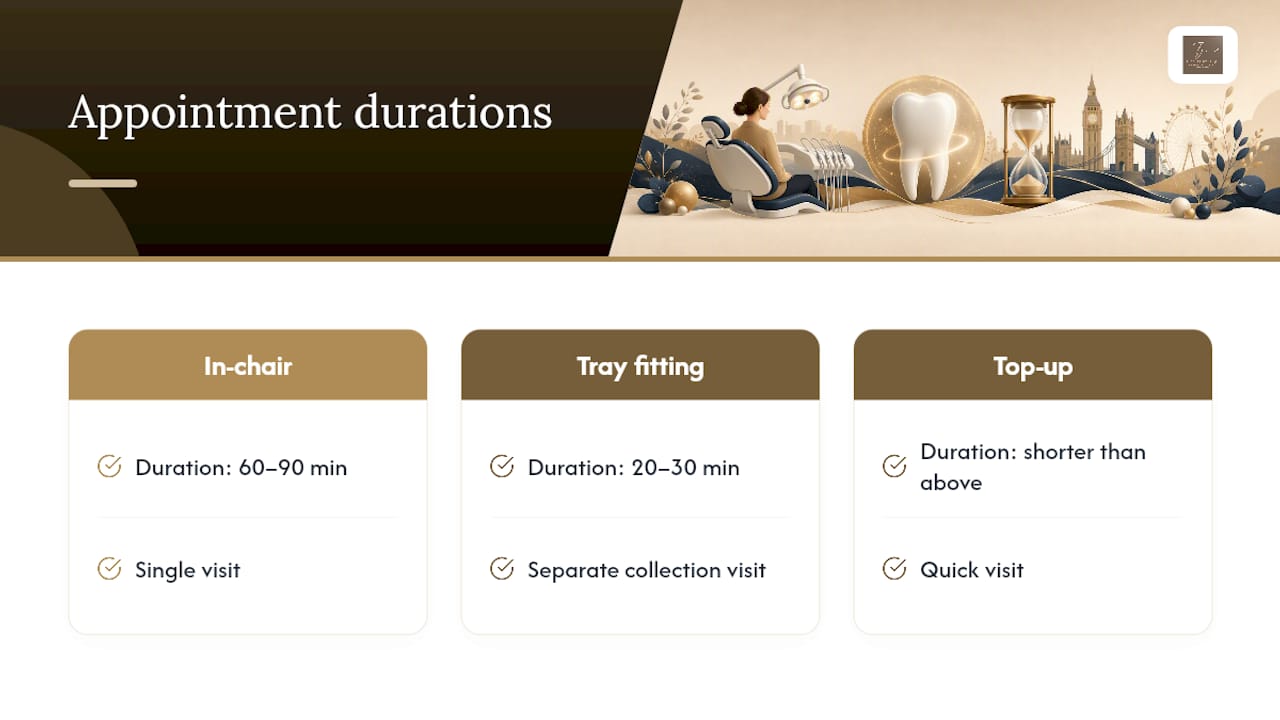
In-chair sessions typically run 60 to 90 minutes; take-home tray fittings are usually quicker, often 20 to 30 minutes to take impressions, followed by a separate collection visit. A top-up appointment or a fresh batch of gel takes far less time than either.
Private UK pricing varies by clinic and by whether you’re having in-chair treatment, take-home trays, or a combination, so budget for a consultation to get an accurate figure rather than relying on a headline price. Book a review when you notice visible shade relapse, when photos taken a few months apart show a duller smile compared with your original result, or simply as a matter of routine around the six to twelve month mark, before staining has properly set back in.
Who’s behind this whitening guidance?
This guidance reflects the clinical approach of Dr Tashfeen Jamil (BDS, MFDS RCS Ed, AssocFCGDent, GDC 286427) at TJ Smile Studio in Glasgow. The clinic offers professional in-chair whitening, bespoke take-home trays fitted to your own bite, and a fully digital workflow that speeds up planning without cutting corners on assessment. Appointments are flexible, and every whitening plan is built around your starting shade, habits, and how long you want the result to last.
What conventional whitening advice gets wrong
Most whitening advice treats the treatment as a single event: book it, do it, admire the result, forget about it. That’s the wrong frame, and it’s why so many people feel let down six months later when their smile has quietly drifted back towards where it started.
The evidence points somewhere more useful. Whitening behaves less like a paint job and more like a garden; it needs periodic attention, not a one-off transformation. A short monthly tray top-up, taken seriously, does more for long-term shade retention than any premium whitening product marketed as a “final” solution. The habit matters more than the strength of the gel.
I’d also push back on the idea that everyone needs the strongest available treatment. Someone with mild extrinsic staining from coffee gains little from aggressive in-chair bleaching if a well-maintained take-home routine gets them the same practical result with less sensitivity. Matching the method to the actual stain, rather than defaulting to the most intensive option, is where most patients get better value. And for anyone with significant intrinsic discolouration, no amount of top-up gel will fully solve it; that’s a conversation about veneers or bonding, not another round of bleaching.
— Dr Tashfeen Jamil BDS, MFDS RCS Ed, AssocFCGDent - GDC 286427
Ready to whiten and keep it that way?
TJ Smile Studio treats whitening as an ongoing plan, not a single appointment, so you leave with both a brighter shade and a clear routine for keeping it that way.
Every whitening patient receives a bespoke take-home tray fitted to their own teeth, built through a digital workflow that means less waiting and a better fit than generic kits. If your staining runs deeper than surface level, the clinic’s digital smile makeover service can map out veneers or bonding alongside whitening for a fuller result. Book a consultation to get a personalised assessment of your starting shade, your realistic timeline, and the maintenance plan that fits your habits.
This article is general information, not a substitute for advice from a qualified doctor. Consult a qualified healthcare professional about your own circumstances before acting on anything here.
Sources
- Teeth whitening - NHS
- Clinical review on tooth whitening — PMC article
- Tooth whitening information for adult patients - Leeds Dental Institute
FAQ
Do teeth go back to normal after whitening?
Yes, gradually. Whitening fades over time as new staining builds up, though good maintenance (rinsing after staining drinks, regular cleanings, occasional tray top-ups) slows the process considerably.
How long do professionally whitened teeth last?
In-chair professional whitening typically lasts one to three years, with the NHS citing around three years as a realistic outcome when patients follow dentist advice and maintain results with occasional top-ups.
Is it worth getting teeth whitened?
For extrinsic staining from coffee, tea, wine, or tobacco, professional whitening usually delivers a noticeable, lasting improvement, especially compared with over-the-counter kits that fade within weeks or months.
Can yellow teeth be whitened again?
Yes. Whitening can be repeated once existing results fade, and many clinics offer top-up sessions using leftover take-home trays rather than a full new course, which is quicker and gentler on sensitivity.
Recommended
This article is general information, not personal dental advice. What’s right for your teeth depends on a clinical examination — the condition of your enamel, gums, bite and any existing dental work — and no article can assess that. Outcomes vary between patients, and all treatment at TJ Smile Studio is subject to assessment and clinical suitability.
- Dr Tashfeen Jamil BDS, MFDS RCS Ed, AssocFCGDent, PGDip Restorative and Aesthetic Dentistry — GDC registration 286427
This article is general information, not personal dental advice. What's right for your teeth depends on a clinical examination — the condition of your enamel, gums, bite and any existing dental work — and no article can assess that. Outcomes vary between patients, and all treatment at TJ Smile Studio is subject to assessment and clinical suitability.
Clinically reviewed by Dr Tashfeen Jamil BDS, MFDS RCS Ed, AssocFCGDent, PGDip Restorative and Aesthetic Dentistry — GDC registration 286427, Principal Dentist at TJ Smile Studio, 1 Spiersbridge Way, Thornliebank, Glasgow G46 8NG.
If you have dental pain, swelling or an injury, call the practice on 07728 808510. Out of hours in Scotland, call NHS 24 on 111.